Staying True to Himself
“I was never boy enough to be a boy, I was never girl enough to be girl. I existed in this in between,” said Schuyler Bailar as he stood alone in front of nearly 100 strangers.
At the University of New Hampshire (UNH) on April 17, Schuyler Bailar, a full-time college senior at Harvard shared his story of becoming the first transgender male NCAA D1 athlete. The swimmer was asked to present by the Office of Multicultural Student Affairs, UNH Athletics, Trans UNH and Alliance for a current lecture series titled “Trans is Beautiful.” The event took place in the Memorial Union Building’s, Strafford room. While UNH is spending the month of April to focus on Gay pride, referring to it as “Gaypril” in celebration of LGBTQIAP +, this is something Bailar says he openly celebrates every day.
The Asian-American who is half Korean on his mother’s side, did not always identify himself with the pronouns of he/him/his. With a birth certificate that reads “female,” Bailar spent a long time struggling with his gender identity.
Growing up in McLean, Virginia and attending Georgetown Day School from kindergarten through his senior year, Bailar faced therapy sessions, eating disorders, self-harm and depression. Unsure of where these issues stemmed from, he ended up spending 131 days at the Oliver Pyatt Center for eating disorders following his senior year of high school. This was after Bailar had been recruited to swim for Harvard’s women’s swim team. Ultimately, his choice resulted in a gap year and putting his collegiate swimming dreams on hold.
“This was the first place in my life where I had to slow down,” Bailar said. “I don’t know if you can tell by the way I am speaking, but I am trying very hard to speak slowly. I am a very fast paced person, I like to be busy, I like to fill my life with things. This place asked me to stop. I wasn’t allowed to see my family, my friends. I didn’t eat any of the same foods, I wasn’t allowed to exercise or swim, which was my main, grounding thing. I wasn’t even allowed to use my cell phone.”
It was at the Oliver Pyatt Center through therapy and talking where Bailar was confronted with his unavoidable truth, that he is transgender.
With everything out in the open, he had to tell his Harvard swim coach, Stephanie Wriede Morawski, of his news. Morawski supported Bailar every step of the way throughout his gap year through weekly phone calls to the Oliver Pyatt Center. It was once again time for Bailar to be honest with himself and let her know.
After multiple conversations with Morawski and Kevin Tyrrell, the head coach of the men’s swim team, Bailar was faced with the most difficult decision of his life: compete as a female, something he had done since he was seven, or embrace the male gender and identity he did in every other aspect of his life. Morawski’ s immense support is ultimately what led Bailar to join the men’s team instead of women’s; the team he was initially recruited for. Deciding that he would embrace his male gender, Bailar received a mastectomy, a removal of the breasts in order to wear the male swim requirements. This is commonly referred to as top-surgery.
During Bailar’s lecture, he scrolled through a slideshow of pictures from his youth, reminiscing of what his life has been like up to this point. He says something he’s struggled with for much of his life was finding happiness within himself. In many of his pictures from his childhood, Bailar sported short haircuts, baggy t-shirts and cargo shorts. It was his classmates and the social pressure he received that ultimately made him decide to start dressing more like a girl than a boy. He stops on a picture of him on a skateboard, smiling, announcing to the crowd, that this was him as a girl. With long black hair, a light blue tank top and short jean shorts, gasps come from the audience; disbelief that this is the same person standing in front of them now. With a smile, he lifts his right arm up and says, “Look I’m still wearing the same electric green watch today.”
Walking onto the stage presenting his life story in front of hundreds of strangers is something Bailar does as often as his schedule allows. Opening up to people about what he’s experienced is one of the ways he allows himself to stay true to who he is and spread awareness about people who are transgender. A goal he has set for himself, and says he owes himself.
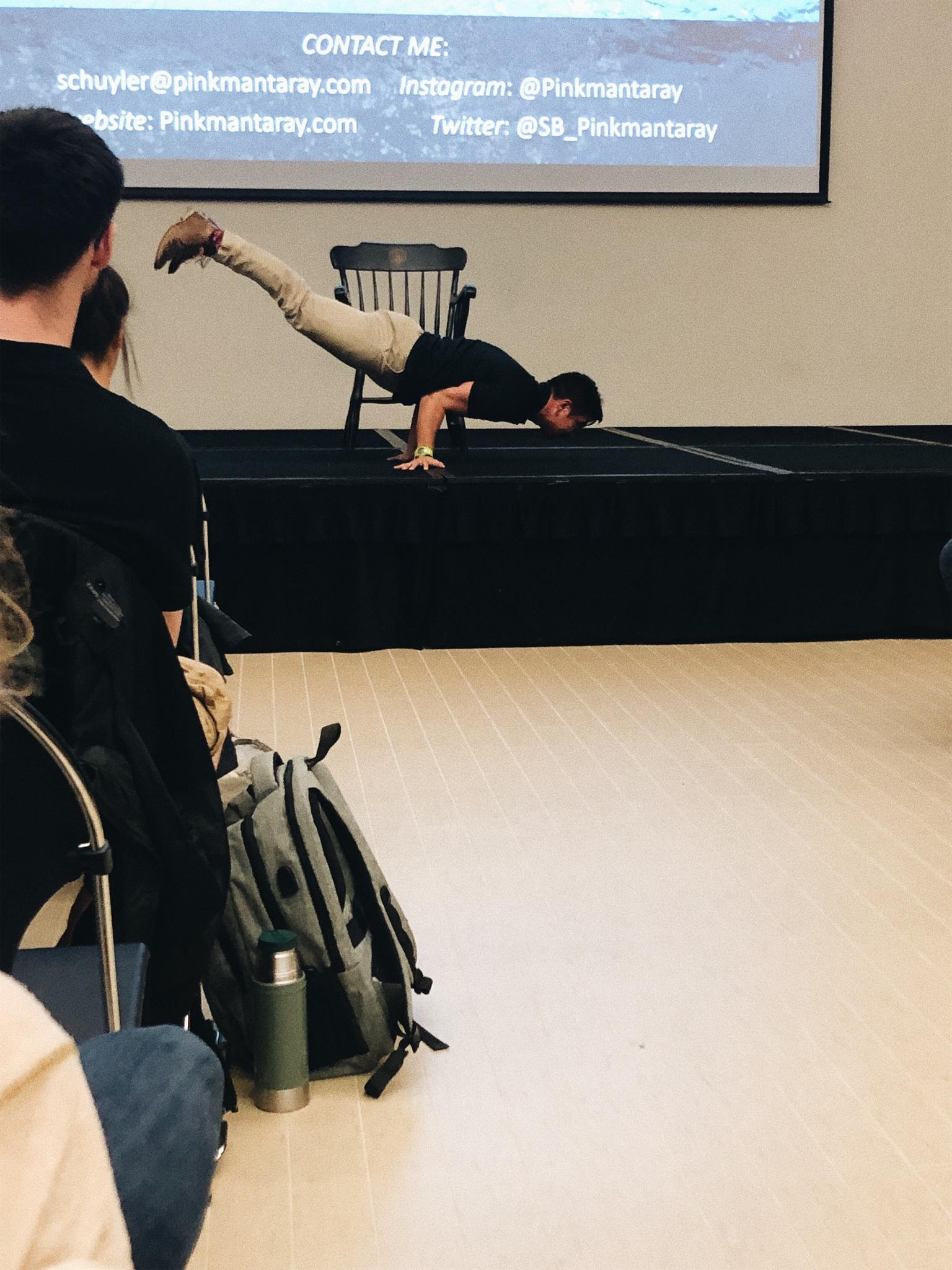
Bailar shows more pictures from when he was a child, each photo showing from when he still identified as female. In one, he is levitating himself in the air with just his arms supporting the weight of his body. He jokes that his mom has pictures of him in this pose in every location they’ve taken a family trip to.
“Remind me to show you guys this pose later if we have time,” Bailar said before moving to the next slide.
Today, the 22-year old’s life is spent embracing the struggle that led to this decision, speaking to organizations such as the Central Intelligence Agency (CIA) and elementary schools. He spoke on Ellen, the Olympic Channel Identify Series and interviewed with 60 Minutes. Reaching out to anyone who will listen. He does this to spread awareness, talk about stigmas, and break down the difficult questions about gender identity.
Bailar finished his collegiate swimming career as of February and will graduate in May of this year; giving him more time to focus on public speaking and his social media presence. With a follower base of 70 thousand people on Instagram, his story has impacted many.
Standing in front of strangers isn’t something that even shakes the young man. Interacting with his audience, cracking jokes, and openly talking about his experiences from his youth to the present day is something he enjoys.
As he prepares for graduation with a degree in psychology, Bailar has accepted a job in Seattle where he will be teaching emotional intelligence skills to employees at a finance company. He negotiated a deal with this company that he would accept this job on the sole factor that at least once a week he could speak with other groups and organizations world-wide; continuing to do what he does now.
Through a Q and A session he provides at nearly all his events, he lets the audience know to ask him the “real questions.”
“What I mean by that is I think that people tip-toe around trans people because we are going to break,” Bailar said. “I might trip and fall but that is not because of your questions. I am not going to break, and you are not going to ask me something a seven-year-old hasn’t already asked me. If you think the question is rude or offensive, then definitely ask it. I say that because, I think those questions are important to talk about. You won’t learn the same things from asking Google versus asking a real life trans person.”
Caroline, a transgender woman from New Hampshire, attended the event with her partner. She raised hand to ask a question. After following Bailar since before his top surgery, she compliments him on how his social media presence positively effects his followers.
“What strikes me about you, is your self-reflection and your betterment,” Caroline said. “When you do your dialogues on social media, you internally and externally process, which is extremely healthy. I think you’re an anomaly to the trans community.”
Lily Greenburg, a UNH graduate student in creative writing, raised her hand next.
“Thank you so much for being here,” Greenburg said. “I’m just wondering what your family’s process was through your transition? Were they supportive?”
“I always say that my parents met me with love at every turn and every decision,” Bailar said. “They did not always understand everything I went through, but that’s ok. I think that some trans people and people in general think that people have to understand something in order for them to accept it. The reality is you don’t have to understand it, you don’t have to get it. I don’t get multi-variable calculus, but it doesn’t make it any less true. It doesn’t make their theorems false because I don’t get it. The reason I share that is sometimes parents say, “I don’t get it, so you can’t be trans.” But, it’s like, “No. You don’t get it and I am trans.” Right? My parents did a very good job of saying, “listen this is your experience, I don’t understand, please help me.””
In the audience another hand quickly shoots up.
“Hi, my name is Elaina, I am a nursing major here at the University of New Hampshire. Will you show us your yoga pose now?”
“Yes, I can. Let me just put my mic down,” Bailar responds.
Rushing to the podium to put his microphone down and then back to the middle of the stage, Bailar quickly lays on the ground. He places his hands out in front of him and effortlessly raises his legs into the air, creating a levitating plank. The upper body strength of the swimmer is prominent to everyone watching. Amazement quickly fills the faces of those in the crowd.
The hands of many continue to shoot up throughout the hour and a half Bailar has reserved in the Strafford room. Expanding on what life has been like since coming to the realization he is a transgender male, he continues to answer the questions Google cannot.